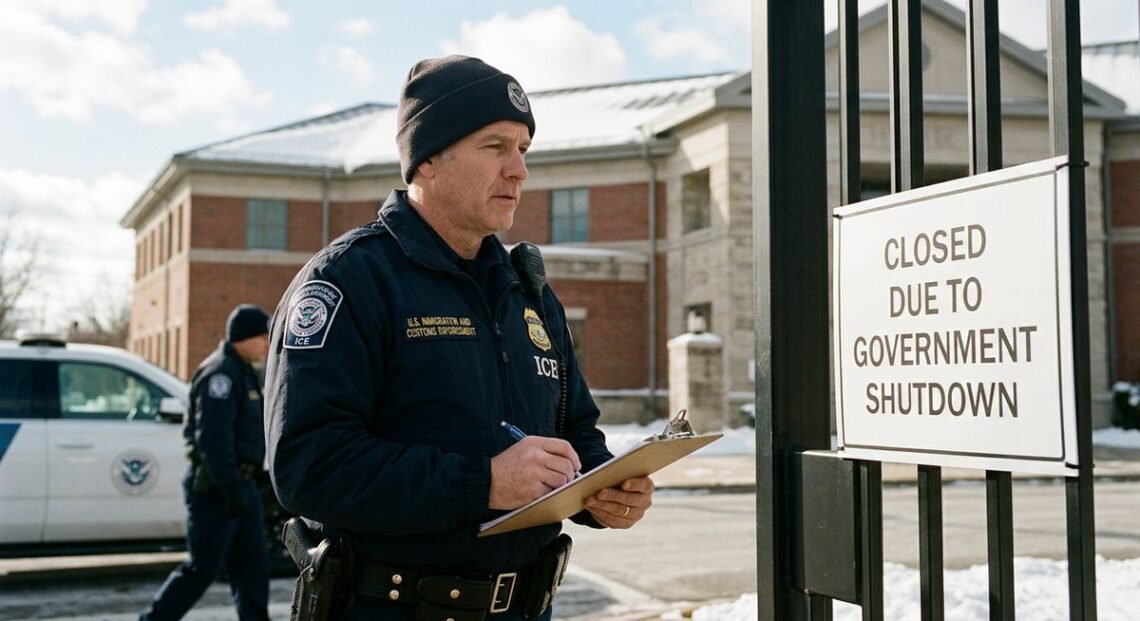
ICE agents and officers are being paid during the 2026 Department of Homeland Security shutdown — a fact that separates them from tens of thousands of other federal workers going without paychecks right now. The funding comes from the One Big Beautiful Bill Act, a sweeping legislative package signed in 2025 that allocated roughly $75 billion for ICE detention operations and $30 billion for general agency functions.
That money was never earmarked for salaries. The Trump administration made the unusual decision to redirect a portion of those discretionary funds toward employee paychecks, first during the 43-day shutdown in the fall of 2025, then again when the current DHS funding lapse began on February 14, 2026. The result is a two-tier system within a single department: ICE and Customs and Border Protection personnel are classified as “exempt” and continue drawing pay, while TSA screeners, FEMA staff, and Coast Guard civilians report to work with no paycheck in sight.
Roughly 260,000 DHS employees are caught in this shutdown. About 90% of them keep working. Only a fraction are actually getting paid.
How ICE Employees Are Getting Paid During the 2026 Shutdown
ICE is being paid during the shutdown through discretionary funding that predates the current budget fight. The One Big Beautiful Bill Act, signed into law in July 2025, pumped approximately $165 billion into the Department of Homeland Security — with the largest single chunks going to immigration enforcement. That funding pool is what keeps ICE paychecks flowing even as Congress fails to pass new DHS appropriations.
The One Big Beautiful Bill Act Funding
According to the Committee for a Responsible Federal Budget (2026), ICE received approximately $45 billion for detention capacity and $30 billion broadly for operations through the OBBBA. Senator Rand Paul noted during Senate floor debate that ICE has nearly $19 billion per year locked in for four years — giving the agency a multi-year financial runway that most federal agencies simply do not have.
The critical detail: none of that money was specifically designated for salaries. The Office of Management and Budget authorized DHS leadership to redirect portions of OBBBA discretionary funds toward employee compensation. That same approach was used during last fall’s 43-day government-wide shutdown, and the White House confirmed in February 2026 that it would follow “the same logic and rationale” for the current funding lapse.
Representative Rosa DeLauro, ranking member of the House Appropriations Committee, put it bluntly: “ICE would be able to sustain regular operations for multiple years” on existing OBBBA funding alone. Even without a single new dollar from Congress, the agency is operating with roughly 87% more funding than its pre-OBBBA baseline.
Exempt Status — A Different Category Than “Essential”
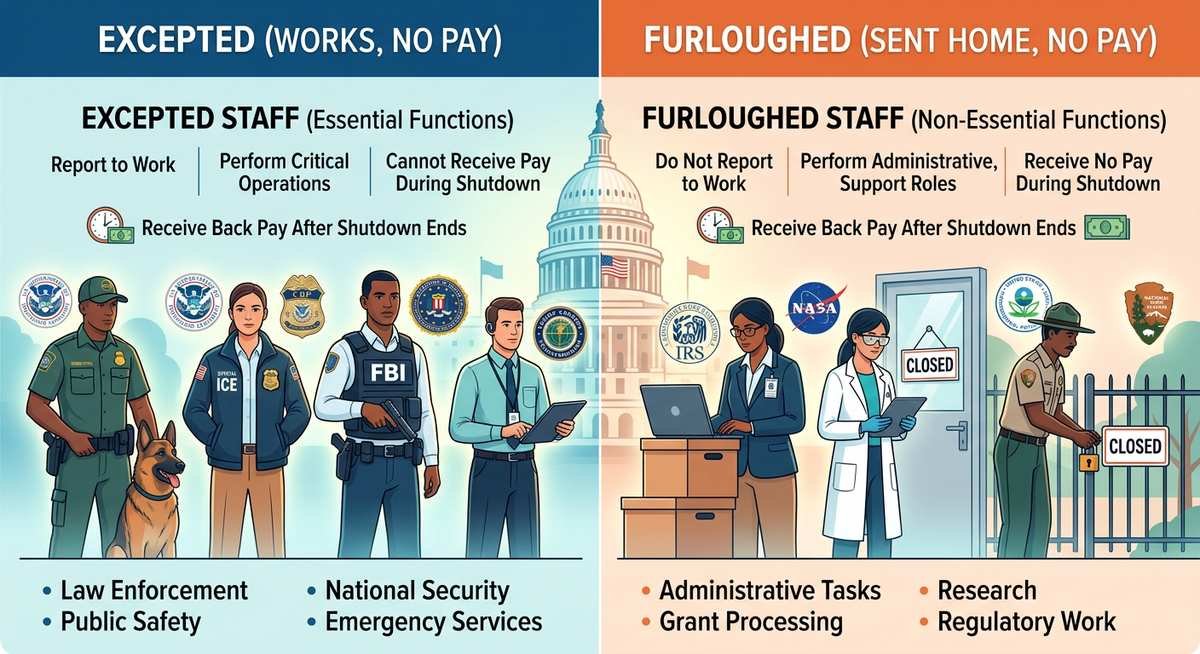
Federal pay during a shutdown involves three distinct employee categories, and the differences matter enormously. ICE employees getting paid through OBBBA funds are classified as “exempt” — not merely “excepted.” That single word changes everything about when money hits their bank accounts.
| Employee Category | Works During Shutdown? | Receives Pay in Real Time? | Legal Basis |
|---|---|---|---|
| Exempt | Yes | Yes — paid on normal schedule | Funded by non-lapsed appropriations (OBBBA) |
| Excepted (Essential) | Yes | No — back pay after shutdown ends | Antideficiency Act safety-of-life exception |
| Furloughed (Non-Excepted) | No — sent home | No — back pay after shutdown ends | No appropriations authority to work |
CBP confirmed in February 2026 that over 57,600 of its employees would be classified as exempt and continue receiving paychecks during the DHS shutdown. ICE operates under the same OBBBA funding structure. According to the Federal Benefits Advisory Service (2026), only exempt employees continue working with pay — excepted employees are required to work but collect nothing until Congress acts.
Why ICE Is Being Paid When Other Federal Workers Are Not
ICE is being paid during the government shutdown because it has access to a funding pool that most DHS components do not. The OBBBA gave immigration enforcement agencies billions in multi-year discretionary money. Agencies like TSA, FEMA, and the Coast Guard civilian workforce received no comparable funding — and the disparity is showing up in missed paychecks, food bank lines, and a growing wave of resignations.
The DHS-Only Shutdown Since February 2026
The current funding lapse is not a full government shutdown. Six of twelve federal appropriations bills were already signed into law before the DHS deadline. Only the Department of Homeland Security lost its funding when Congress failed to reach an agreement on immigration enforcement reforms by the February 14 deadline.
Democrats conditioned full DHS funding on reforms to ICE and CBP operations, including requirements for body cameras, visible agent identification, use-of-force policies, and an end to racial profiling. Republicans insisted on funding immigration enforcement without conditions. Neither side blinked, and the shutdown is now in its fifth week with no resolution on the horizon.
Senator Patty Murray confirmed what budget analysts had already calculated: “Congress’ failure to pass a Homeland Security appropriations bill would not shut down ICE or CBP.” The OBBBA funding makes that mathematically true. The political fight is real, but ICE’s operational funding is insulated from it.
The Pay Disparity Across DHS
The gap between ICE paychecks and everyone else’s has become one of the most visible fault lines in the 2026 shutdown. TSA employs roughly 50,000 screeners classified as excepted — working full shifts at airports across the country without receiving a dime. By mid-March, the agency reported over 300 resignations directly attributed to the pay lapse, along with increasing sick calls and growing security lines at major airports.
| DHS Agency | Employees Affected | Being Paid During Shutdown? | Funding Source |
|---|---|---|---|
| ICE | ~20,000 | Yes (exempt via OBBBA) | One Big Beautiful Bill Act |
| CBP | 57,600+ paid; ~5,600 excepted unpaid | Mostly yes (exempt via OBBBA) | One Big Beautiful Bill Act |
| TSA | ~50,000 | No (excepted — working without pay) | No OBBBA allocation |
| FEMA | ~84% excepted | No (excepted — working without pay) | Disaster Relief Fund for emergencies only |
| Coast Guard (civilian) | Thousands | No (excepted — working without pay) | No OBBBA allocation |
| CISA | 888 excepted of 2,341 | No (excepted — working without pay) | No OBBBA allocation |
FEMA’s situation is particularly stark. According to the DHS contingency plan published ahead of this shutdown, approximately 84% of FEMA staff are designated excepted. They continue working on disaster preparedness and response — but without the multi-year OBBBA cushion that ICE enjoys. Federal employee unions, including the American Federation of Government Employees, have described the two-tier pay system as “cruel and unnecessary.”
Federal Employee Pay Rules During a Government Shutdown
All federal employees stop receiving pay the moment appropriations lapse — unless they are funded through a separate, non-expired source like the OBBBA. The Antideficiency Act (31 U.S.C. Section 1341) prohibits agencies from spending money that has not been appropriated, and that prohibition extends directly to payroll processing. No appropriation, no paycheck.
How the Antideficiency Act Controls Federal Pay
The U.S. Office of Personnel Management’s shutdown guidance requires agencies to immediately defer compensation for excepted employees and cease payroll entirely for furloughed workers. Treasury Department payroll systems enforce this automatically. An excepted employee can work a full two-week pay period during a shutdown and see a stub showing zero dollars. That is the law functioning exactly as designed.
The narrow exception carved out by the OBBBA is what makes ICE’s situation unusual. Because the One Big Beautiful Bill Act funds were appropriated in 2025 and span multiple fiscal years, they have not lapsed. ICE employees paid from those funds are technically receiving compensation from valid, unexpired appropriations — even though the agency’s regular annual funding has expired. The legal mechanism is sound. The optical disparity is enormous.
Which ICE Roles Get Paid and Which Do Not
Most ICE employees are currently being paid, but a small number of administrative and support positions fall outside the exempt classification. The breakdown follows a simple rule: if the role is tied to enforcement operations or detention management, it is exempt and paid. If the role is purely administrative — routine HR processing, non-urgent policy analysis, internal help desk — it may be excepted (working without pay) or furloughed (sent home).
| ICE Position | 2026 Shutdown Status | Getting Paid? |
|---|---|---|
| ERO Deportation Officers | Exempt | Yes |
| HSI Special Agents | Exempt | Yes |
| Detention Facility Staff | Exempt | Yes |
| ICE Attorneys (active cases) | Exempt | Yes |
| IT Specialists (mission-critical) | Exempt | Yes |
| Administrative/Clerical Staff | Excepted or furloughed | No |
| Non-urgent Policy Analysts | Furloughed | No |
DHS shutdown contingency plans consistently designate well over 90% of ICE personnel as essential to ongoing operations. During the 35-day shutdown of 2018-2019, the longest in U.S. history, the vast majority of ICE’s roughly 20,000-strong workforce reported to duty every day without receiving a paycheck for over a month. The OBBBA funding has fundamentally changed that dynamic for the current shutdown.
Will ICE Keep Getting Paid if the Shutdown Continues?
ICE will continue receiving pay for the foreseeable future, even if the DHS funding standoff drags on for months. The OBBBA’s multi-year funding structure gives the agency a financial runway that extends well beyond any realistic shutdown timeline. And for the small number of ICE employees who are excepted rather than exempt, federal law guarantees they will eventually receive every dollar owed.
OBBBA Multi-Year Funding Runway
Senator Rand Paul stated on the Senate floor that ICE has approximately $19 billion per year in locked-in funding spanning four fiscal years. CBS News reported that even if Congress never passes a new DHS appropriations bill, ICE would still be operating with roughly 87% more funding than its pre-OBBBA annual budget. The agency is not running on fumes — it is running on a multi-year funding surplus that insulates it from the standard shutdown consequences.
The practical implication is clear: ICE agents, officers, and workers will keep getting paid during the shutdown for as long as OMB continues directing OBBBA funds toward payroll. Nothing in the current political standoff threatens that funding source, because it was already signed into law in 2025.
The Back Pay Safety Net for All Federal Employees
For federal employees outside the OBBBA umbrella — including the small fraction of ICE staff not classified as exempt — the Government Employee Fair Treatment Act of 2019 provides a legal guarantee of back pay. Signed into law on January 16, 2019, after the record 35-day shutdown, GEFTA ensures that both excepted and furloughed employees receive retroactive compensation once funding is restored. No separate congressional vote required.
According to OPM guidance, back pay processing typically takes one to two full pay cycles after a shutdown ends — meaning a two-to-four-week wait before missed wages appear in bank accounts. The guarantee is absolute, but it does not cover late fees, mortgage penalties, or the financial stress that accumulates while waiting. Representative Bill Huizenga’s proposed Pay Our Homeland Defenders Act of 2026 would make real-time shutdown pay permanent for DHS law enforcement, eliminating the need for OBBBA workarounds entirely.
Frequently Asked Questions
Is ICE shut down during the government shutdown?
No. ICE is not shutting down, shut down, or closed due to the government shutdown. The agency continues full enforcement operations — arrests, detentions, deportations, and criminal investigations — funded through the One Big Beautiful Bill Act. Only a small number of non-essential administrative functions are paused.
Are ICE agents being paid during the federal shutdown?
Yes, ICE agents are being paid during the 2026 DHS shutdown. The Trump administration redirected discretionary funds from the One Big Beautiful Bill Act to cover ICE and CBP employee salaries. Agents classified as exempt continue receiving paychecks on a normal schedule, unlike excepted employees at other DHS agencies who work without immediate pay.
Are ICE officers and workers being paid during the shutdown?
Most ICE officers and workers are being paid. Enforcement and Removal Operations officers, Homeland Security Investigations special agents, deportation officers, and detention facility staff are classified as exempt and receive regular paychecks. A small number of administrative and non-mission-critical staff may be excepted (working without pay) or furloughed (sent home without pay).
Will ICE employees keep getting paid if the shutdown continues?
Yes. ICE has approximately $19 billion per year in locked-in OBBBA funding spanning multiple fiscal years. This gives the agency a multi-year financial runway that is unaffected by the current DHS appropriations standoff. ICE employees will continue receiving paychecks regardless of how long the shutdown lasts.
Is anyone at ICE not getting paid during the shutdown?
A small number of ICE employees in purely administrative roles — routine HR functions, non-urgent policy analysis, internal IT support — may not be receiving pay during the shutdown. These positions are classified as excepted (working without pay) or furloughed (sent home). They are guaranteed back pay under the Government Employee Fair Treatment Act of 2019 once funding is restored.
Do federal employees and government workers get paid during a shutdown?
No. Most federal employees do not get paid during a government shutdown. Only “exempt” employees — those funded through non-lapsed appropriations like the OBBBA — receive real-time paychecks. “Excepted” government workers continue reporting to duty without pay, and furloughed employees are sent home without pay. All categories are guaranteed back pay after the shutdown ends, but that payment can take two to four weeks to process.
Is ICE still being paid right now during the shutdown?
Yes, as of March 2026, ICE employees classified as exempt are still receiving regular paychecks. The DHS shutdown that began February 14, 2026, has not affected ICE’s ability to pay its workforce through OBBBA discretionary funds. This stands in sharp contrast to TSA, FEMA, and Coast Guard civilian employees who have missed full paychecks since mid-March.
Does ICE always get paid during shutdowns?
Not historically. During the 35-day shutdown of 2018-2019, ICE employees worked without pay for over a month before receiving back pay. The OBBBA funding mechanism that keeps ICE paid during the 2026 shutdown is a recent development — it depends on the continued availability of multi-year discretionary funds and OMB’s willingness to direct those funds toward salaries.
Where Things Stand
ICE employees are being paid during the 2026 DHS shutdown, and they will keep getting paid for the foreseeable future. The One Big Beautiful Bill Act’s multi-year funding gives the agency a financial cushion that insulates it from the standard consequences of a congressional funding lapse. ICE agents, officers, and workers across enforcement and detention roles are classified as exempt, not merely excepted — and that classification is the difference between a paycheck arriving on time and a paycheck arriving weeks or months late.
The same cannot be said for tens of thousands of other DHS employees. TSA screeners, FEMA personnel, and Coast Guard civilian workers are shouldering the full weight of this shutdown without the OBBBA safety net. They are guaranteed back pay under the Government Employee Fair Treatment Act of 2019, but that guarantee does nothing for the mortgage payment due next week. The shutdown is now in its fifth week, and the political standoff that caused it shows no clear path to resolution.

