
Yes, ICE employees do get paid during a government shutdown — but not on time. Immigration and Customs Enforcement agents and officers are classified as “excepted” employees under federal law, meaning they must continue reporting to work even when Congress fails to pass an appropriations bill. Their paychecks, however, are legally delayed until funding is restored.
The back pay guarantee isn’t informal policy or agency goodwill. The Government Employee Fair Treatment Act of 2019, signed into law following the brutal 35-day shutdown of 2018–2019, legally mandates that excepted federal workers receive all missed wages as soon as an appropriations measure is signed. The money comes — it just comes late, often in a single lump-sum “supercheck” that arrives after potentially weeks of financial limbo.
That distinction matters enormously for an ICE officer earning a GS-7 salary who has a mortgage due on the first. The legal framework, how DHS funding mechanisms make ICE more insulated than most federal agencies, and what the real paycheck math looks like for agents across the pay scale — all of that shapes what a shutdown actually costs the people enforcing immigration law while Congress negotiates.
What “Excepted” Status Actually Means for ICE Employees
ICE employees are legally required to report to work during a government shutdown — without pay — because federal law classifies their roles as “excepted” from the normal funding suspension. The distinction isn’t semantic. It determines whether an employee faces criminal liability for staying home, and it directly controls when a paycheck finally arrives.
The Anti-Deficiency Act
The Anti-Deficiency Act, codified at 31 U.S.C. § 1341, prohibits federal agencies from obligating or spending money that Congress has not appropriated. When a fiscal year ends without a passed appropriations bill or continuing resolution, that prohibition kicks in immediately — forcing agencies to suspend most operations and place non-critical employees on furlough without pay.
The law carves out a narrow exemption: agencies may continue activities that protect human life or property, or that are otherwise authorized by law to continue. ICE’s core law enforcement mission — immigration enforcement, criminal investigations, detention operations — falls squarely within that exemption. Stopping those functions mid-operation would create genuine public safety gaps, so the Anti-Deficiency Act effectively mandates that ICE keep running.
The practical result is that nearly the entire ICE workforce continues reporting to duty during a lapse in appropriations, unlike agencies such as the National Park Service or the IRS, where the majority of employees are furloughed within days.
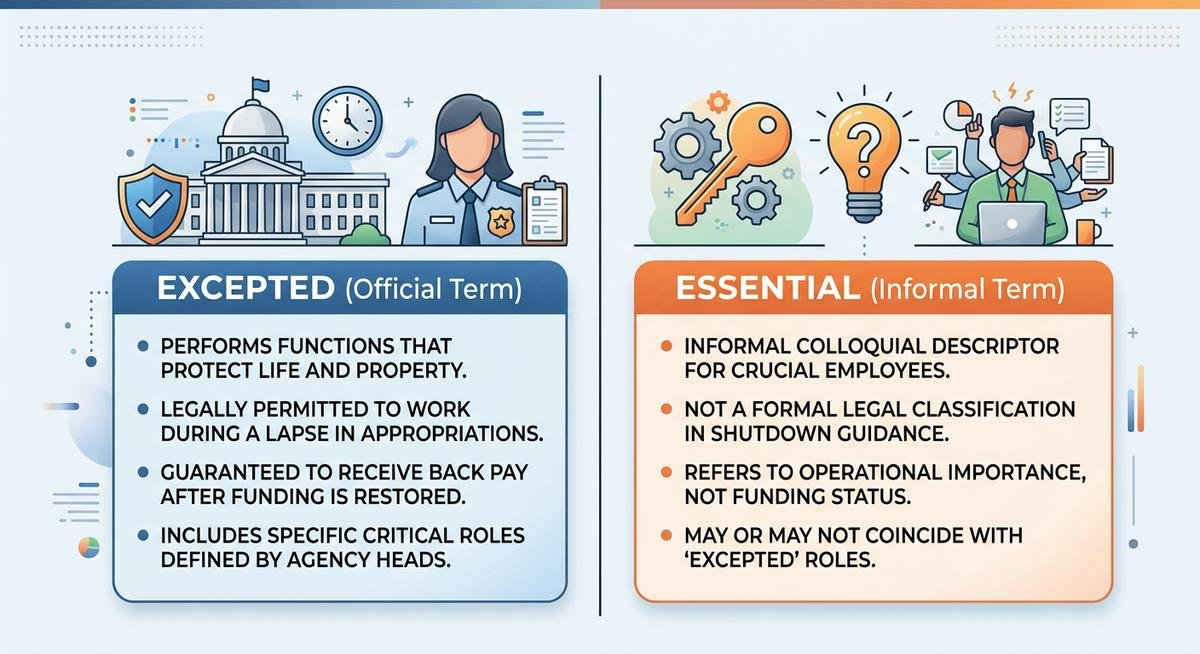
«Excepted» vs. «Essential» — Why the Distinction Matters
“Essential” is the word politicians and cable news anchors reach for. It is not a legal term. No statute, Office of Personnel Management regulation, or agency shutdown contingency plan uses “essential” as a classification with binding effect.
“Excepted” is the operative statutory term. Under OPM guidance, an excepted employee is one whose work is authorized to continue during an appropriations lapse — and who is therefore legally obligated to show up. Refusing to report can expose a federal employee to disciplinary action.
| Term | Source | Legal Force | What It Means in Practice |
|---|---|---|---|
| Excepted | Anti-Deficiency Act / OPM | Statutory — binding | Must report to work; pay is deferred until appropriations pass |
| Essential | Media / informal usage | None — no legal definition | Colloquial shorthand; creates public confusion about pay and obligations |
| Furloughed | Anti-Deficiency Act / OPM | Statutory — binding | Must not report to work; historically uncertain whether back pay would follow |
The confusion between “excepted” and “essential” matters beyond terminology. Employees who misunderstand their classification may incorrectly believe they have a choice about reporting — or that their pay timeline operates differently than it actually does. For ICE officers and agents, there is no choice: excepted status means work continues, the paycheck is delayed, and the legal obligation to show up is non-negotiable.
When and How ICE Employees Actually Get Paid
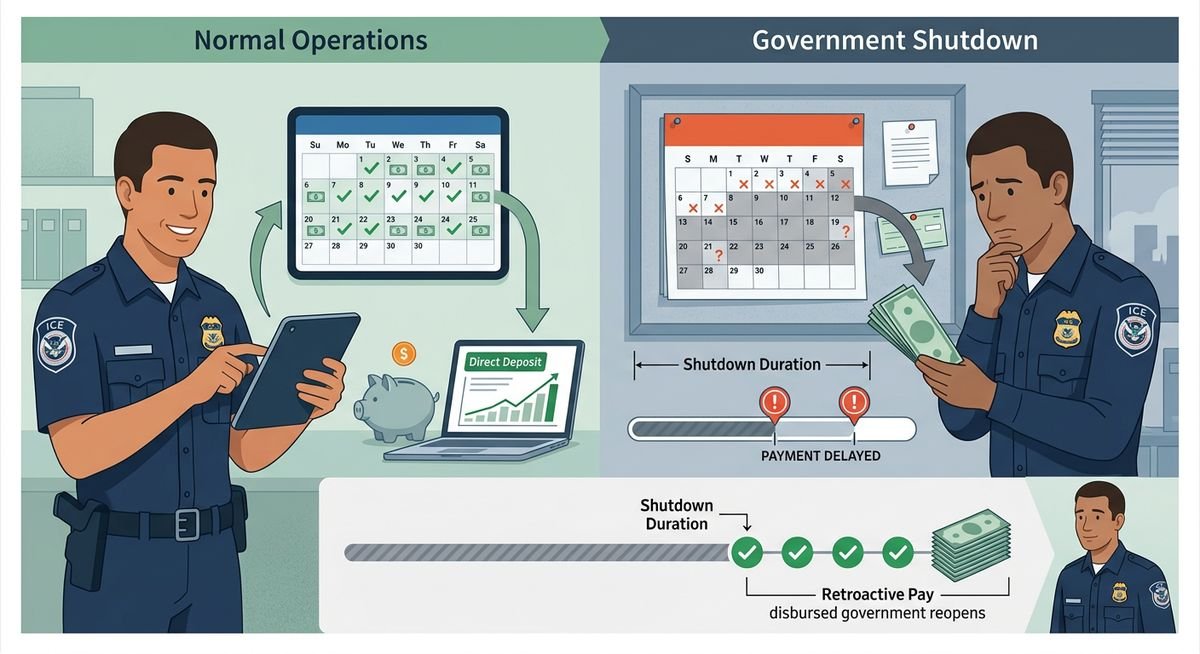
ICE employees working through a shutdown are legally guaranteed to receive every dollar of missed pay — but the timing is the problem. Under the Government Employee Fair Treatment Act of 2019, back pay is automatically triggered the moment an appropriations bill is signed, meaning the guarantee is ironclad. The hardship isn’t whether they get paid. It’s the gap between the last normal paycheck and the eventual lump-sum catch-up.
The Government Employee Fair Treatment Act of 2019
Before this law existed, back pay for excepted federal workers was technically discretionary — Congress had to pass a separate bill authorizing it after each shutdown. That changed permanently after the 2018–2019 shutdown stretched to 35 days, the longest in U.S. history at the time, leaving roughly 420,000 excepted federal employees working without pay for over a month.
The Government Employee Fair Treatment Act of 2019, signed into law by President Trump on January 16, 2019 — while the shutdown was still ongoing — made back pay automatic and mandatory. No additional legislation required. The moment a continuing resolution or full appropriations bill is enacted, the Treasury is legally obligated to issue back pay to all excepted employees as soon as administratively feasible.
That phrase, “as soon as administratively feasible,” matters. It doesn’t mean the next business day. It typically means the next scheduled pay cycle after the shutdown ends, which can add another one to two weeks to the delay depending on where the shutdown falls in the biweekly federal pay calendar.
How the “Supercheck” Works in Practice
Federal employees and payroll administrators informally call it the “supercheck” — a single lump-sum payment covering every missed pay period, deposited in one shot after the shutdown resolves. For a 35-day shutdown, that’s roughly two and a half pay periods arriving simultaneously. For a shutdown approaching 43 days, it can be three full pay periods in one deposit.
The administrative burden on federal payroll systems is significant. The National Finance Center, which processes payroll for dozens of federal agencies including DHS components, has to reconcile missed pay periods, apply any retroactive overtime or LEAP calculations, and push corrected records through the system — all while simultaneously processing the current active pay period. Errors and delays in individual employee accounts are not uncommon during this crunch.
For employees living paycheck to paycheck, the supercheck arrives too late to prevent real damage. Rent, car payments, and utility bills don’t pause for appropriations negotiations. Many ICE employees have reported taking out short-term loans or drawing on emergency savings during extended shutdowns, only to repay those debts once the lump sum arrives.
What ICE Employees Earn — The Real Financial Stakes
The financial pressure of a delayed paycheck scales directly with where an employee sits on the federal pay scale. Entry-level ICE officers typically start at GS-5 or GS-7, with base salaries ranging from roughly $33,000 to $47,000 annually depending on locality pay adjustments. Senior special agents and supervisory personnel can reach GS-13 through GS-15, where base salaries climb into the $112,000–$143,000 range before additional compensation.
Nearly all ICE law enforcement personnel also receive Law Enforcement Availability Pay, known as LEAP, which adds 25% to base salary in exchange for being available for unscheduled duty beyond a standard workweek. LEAP is factored into back pay calculations, so it’s not lost — but it’s also not accessible during the gap.
| ICE Position | GS Grade | Base Salary Range | With LEAP (25%) |
|---|---|---|---|
| Deportation Officer (Entry) | GL-5 to GL-7 | $39,576 – $55,231 | $49,470 – $69,039 |
| Special Agent (Mid-Career) | GS-12 to GS-13 | $82,764 – $107,590 | $103,455 – $134,488 |
| Supervisory Agent | GS-14 to GS-15 | $117,962 – $143,736 | $147,453 – $176,300 |
A GS-7 deportation officer losing two biweekly paychecks faces roughly $3,800 in missed take-home pay — enough to miss rent in most American cities. For a GS-13 special agent, that gap can exceed $7,000. The financial strain falls hardest on junior officers in high-cost-of-living duty stations like New York, Miami, and Los Angeles, where locality pay adjustments raise salaries but housing costs consume most of the increase.
Why ICE and CBP Are More “Shutdown-Proof” Than Other Agencies
ICE and U.S. Customs and Border Protection are among the most insulated federal agencies from shutdown disruption — not because they’re immune to funding lapses, but because Congress and the executive branch have repeatedly treated border enforcement as a category apart. Nearly the entire ICE and CBP workforce qualifies as excepted, meaning operational continuity is essentially guaranteed regardless of what happens on Capitol Hill.
How Dedicated DHS Funding Mechanisms Work
Congress has periodically carved out border security funding from broader continuing resolutions, effectively ring-fencing CBP and ICE operations even when other agencies go dark. The most cited precedent came in 2019, when the Trump administration redirected approximately $3.8 billion in previously appropriated Pentagon funds toward border wall construction — a move that demonstrated how executive-branch prioritization can keep border enforcement funded through channels that bypass the normal appropriations standoff.
The One Big Beautiful Budget Act, passed in 2025, went further by embedding dedicated funding streams for immigration enforcement directly into reconciliation legislation rather than standard discretionary appropriations. That structural shift matters enormously. Reconciliation bills aren’t subject to the same expiration risk as annual appropriations, which means ICE and CBP funding tied to that mechanism doesn’t automatically lapse when a continuing resolution fails.
In practice, this creates a layered funding architecture: even if the top-level appropriations process breaks down, border agencies can draw on separately authorized pools that other agencies simply don’t have access to.
ICE vs. Other Federal Agencies: A Shutdown Comparison
The contrast with other agencies is stark. During the 2018–2019 shutdown, roughly 95% of ICE’s workforce continued reporting to duty as excepted employees. At the Environmental Protection Agency, by comparison, approximately 95% of staff were furloughed — the near-mirror opposite.
| Agency | Approximate % Excepted (Working) | Approximate % Furloughed | Core Reason |
|---|---|---|---|
| ICE | ~95% | ~5% | Law enforcement / public safety mission |
| CBP | ~95% | ~5% | Border security / port operations |
| EPA | ~5% | ~95% | Non-emergency regulatory function |
| IRS | ~12% | ~88% | Limited emergency tax operations |
| National Park Service | ~20% | ~80% | Safety and resource protection only |
The Department of Education essentially closes during a shutdown — its administrative and grant-management functions don’t qualify as law enforcement or public safety activities. ICE agents, meanwhile, are still arresting people, running detention facilities, and executing deportation flights. That operational reality is precisely why DHS has pushed aggressively for dedicated funding mechanisms that keep border agencies paid even when the rest of the government is dark.
Historical Shutdown Context — How ICE Pay Treatment Has Evolved
ICE has operated through every major shutdown since the agency’s creation in 2003, and the legal protections for its employees have changed significantly over that span. The biggest shift came in January 2019, when Congress passed the Government Employee Fair Treatment Act — converting back pay from a political courtesy into a statutory right.
Before that law existed, excepted federal workers had no legal guarantee they would ever be compensated for hours worked during a lapse in appropriations. Congress typically passed back pay legislation after each shutdown, but employees had no enforceable claim until it did. That uncertainty is now gone.
| Shutdown | Duration | ICE Pay Outcome | Key Development |
|---|---|---|---|
| 1995–1996 (Clinton) | 21 days | Back pay passed retroactively | No statutory guarantee; Congress acted voluntarily |
| 2013 (Obama) | 16 days | Back pay passed retroactively | ICE fully excepted; ~800,000 federal workers furloughed elsewhere |
| 2018–2019 (Trump) | 35 days (record at the time) | Back pay legally guaranteed mid-shutdown | Government Employee Fair Treatment Act signed January 16, 2019 |
| 2025 (Trump) | 43 days (longest on record) | Back pay guaranteed under 2019 law | First shutdown where statutory back pay protection was in place from day one |
The 2018–2019 shutdown was the inflection point. Thirty-five days without a paycheck pushed thousands of TSA officers — also DHS employees — to call out sick in protest, creating cascading airport delays and exposing just how financially precarious federal law enforcement work can be. That visible crisis accelerated passage of the Fair Treatment Act.
The 2025 shutdown, at 43 days, surpassed that record. Unlike 2018, ICE employees entered it with a legal back pay guarantee already on the books — a meaningful difference, even if the short-term cash-flow hardship remained identical.
Government Shutdown Impact on Airports, Customs, and International Travel
A government shutdown affects international travel and airport operations primarily through TSA staffing shortages and customs processing delays, not through any halt in ICE enforcement. During the current 2026 DHS shutdown, over 400 TSA officers have resigned, and callout rates at major airports have exceeded 11% nationally — with some hubs like Houston hitting 50% absenteeism.
According to Acting Deputy TSA Administrator Adam Stahl (2026), it is “not hyperbole to suggest that some airports — especially smaller ones — may have to shut down operations entirely if staffing levels continue to decline.” Wait times at Atlanta’s Hartsfield-Jackson International Airport exceeded 2.5 hours in late March 2026, with LaGuardia, JFK, and Houston Bush Intercontinental reporting 40-minute-plus screening queues.
Customs and Border Protection officers at ports of entry also operate as excepted employees, keeping borders functional. However, programs like Global Entry enrollment typically pause during shutdowns, and processing times at land and sea ports slow considerably with reduced administrative support staff.
Frequently Asked Questions
Does ICE get paid during a government shutdown?
ICE employees are guaranteed to receive all pay earned during a shutdown, but the payments are delayed until Congress passes an appropriations bill or continuing resolution. The Government Employee Fair Treatment Act of 2019 makes this back pay automatic and mandatory. During extended shutdowns, ICE personnel may go weeks without a paycheck before receiving a lump-sum “supercheck” covering all missed pay periods.
Do ICE officers and agents get paid during a shutdown?
ICE deportation officers (series 1801) and special agents (series 1811) are classified as excepted employees under the Anti-Deficiency Act, meaning they must continue working through any government shutdown. Their pay is deferred, not forfeited. During the October 2025 shutdown, approximately 70,000 DHS law enforcement personnel received a “supercheck” by October 22, 2025, funded through the One Big Beautiful Bill Act.
Does DHS get paid during a government shutdown?
Most DHS employees continue working as excepted personnel — roughly 90% of the department’s 260,000-plus workforce reports to duty during a shutdown. Pay is deferred until funding resumes. During the February 2026 DHS shutdown, CBP diverted One Big Beautiful Bill Act funds to pay over 57,600 employees, though approximately 5,600 CBP workers and most TSA officers still worked without immediate compensation.
How does ICE get paid during a government shutdown?
ICE employees receive deferred compensation through the federal payroll system once a shutdown ends. The National Finance Center processes retroactive payments covering all missed pay periods, including overtime and Law Enforcement Availability Pay. Since 2025, DHS has also used multi-year funding from the One Big Beautiful Bill Act ($74.9 billion for ICE operations through 2029) to pay certain law enforcement personnel during funding lapses.
Does DOJ get paid during a shutdown?
Department of Justice employees follow the same framework as other federal agencies. Law enforcement personnel — FBI agents, DEA agents, U.S. Marshals — are classified as excepted and must work without immediate pay. Administrative and support staff are generally furloughed. Back pay is guaranteed under the Government Employee Fair Treatment Act of 2019 once funding is restored.
Does a government shutdown affect international travel?
International travel is affected primarily through TSA screening delays and customs processing slowdowns. Airport security checkpoints remain open, but reduced staffing leads to significantly longer wait times. During the March 2026 DHS shutdown, wait times exceeded 2.5 hours at Atlanta Hartsfield-Jackson and topped 40 minutes at LaGuardia and JFK. Global Entry enrollment interviews are typically suspended during shutdowns, and passport processing at State Department offices may slow.
What happens if the government shuts down?
Non-essential federal operations suspend, and employees are either furloughed (sent home without pay) or classified as excepted (required to work without immediate pay). Law enforcement agencies like ICE, CBP, and the FBI continue operations. Social Security checks continue. National parks may close or operate with skeleton staff. The Office of Personnel Management publishes agency-specific contingency plans detailing exactly which functions continue.
How long do government shutdowns last?
The average federal government shutdown since 1976 has lasted approximately 8 days across 20 total shutdowns. The longest was 43 days in 2025. The 2018-2019 shutdown ran 35 days, the 2013 shutdown lasted 16 days, and the 1995-1996 shutdown stretched to 21 days. The current DHS-specific shutdown that began February 14, 2026, has exceeded 36 days as of late March 2026.
Does a government shutdown affect state employees?
State government employees are not directly furloughed during federal shutdowns because they are funded through state appropriations, not federal appropriations. However, state-administered programs that depend on federal funding — including SNAP (food stamps), WIC nutrition assistance, and Head Start — may face disruptions if a shutdown extends beyond 30 days and federal grant disbursements are delayed.
Does a government shutdown affect food stamps?
SNAP benefits are funded through mandatory spending and generally continue during short shutdowns. The USDA can typically issue one month of advance benefits before a shutdown takes effect. However, extended shutdowns beyond 30 days create uncertainty, as the department’s administrative capacity to process new applications and renewals is reduced when staff are furloughed. During the 2018-2019 shutdown, USDA issued February 2019 SNAP benefits early in January as a precaution.
The Bottom Line on ICE Pay During Shutdowns
ICE employees get paid during government shutdowns — eventually. The legal guarantee under the Government Employee Fair Treatment Act of 2019 is ironclad, and the One Big Beautiful Bill Act’s multi-year funding has added a second layer of financial insulation that most federal agencies lack. But “eventually” can mean weeks of missed paychecks for officers earning $40,000 to $70,000 a year in cities where rent alone consumes half that salary.
The pattern from 20 shutdowns since 1976 is consistent: border enforcement continues, ICE agents keep working, and the financial burden falls on individual employees until Congress resolves whatever political standoff triggered the lapse. As Max Stier, president of the Partnership for Public Service, put it: federal workers should not be “collateral in political disputes.” Until structural reform changes that dynamic, the shutdown pay gap remains a recurring cost of doing immigration enforcement in America.
Updated March 23, 2026