
Texas runs one of the largest public health and social services systems in the United States — a $45+ billion operation that puts food on tables, pays for hospital visits, and keeps elderly Texans in their homes rather than nursing facilities. The person responsible for all of it holds the title of Texas Health and Human Services Executive Commissioner.
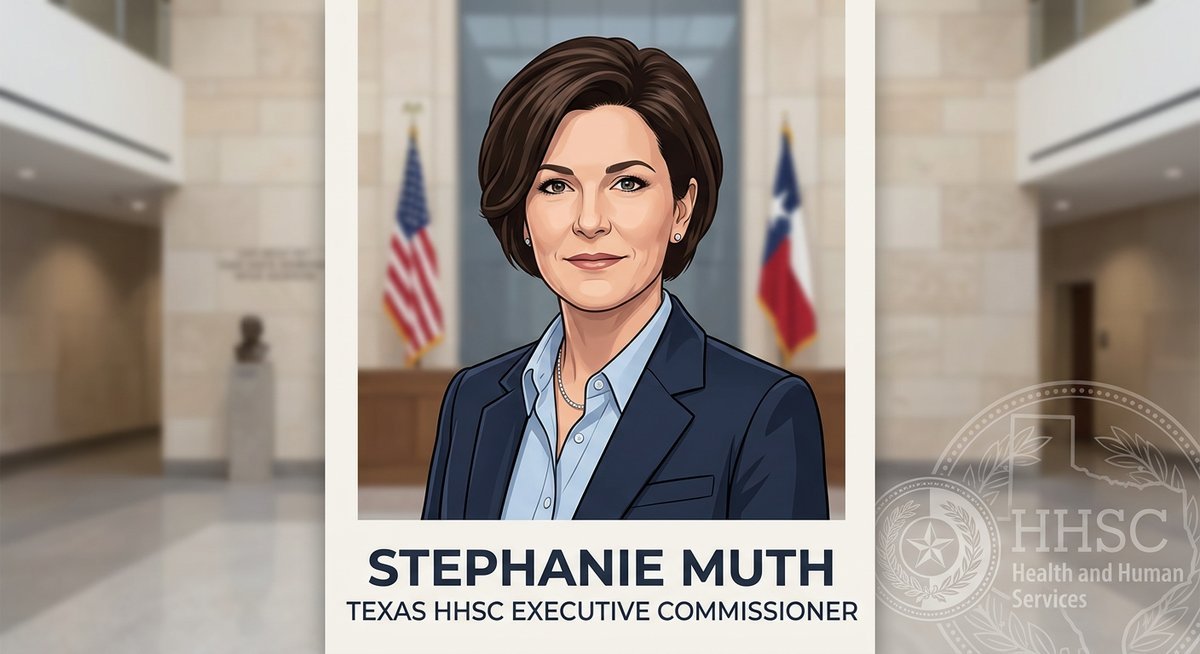
Stephanie Muth assumed that role on January 3, 2026, appointed by Governor Greg Abbott to lead the Texas Health and Human Services Commission (HHSC). A veteran of the agency itself who previously served as State Medicaid Director, Muth returned to HHSC with something most incoming commissioners lack: she already knew exactly where the bodies were buried.
Below is a complete breakdown of who Muth is, what the Executive Commissioner actually does, how the position works legally and politically, and how HHSC’s leadership has evolved since the agency took its modern shape in 2003.
Who Is the Current Texas HHS Executive Commissioner?
Stephanie Muth is the Texas Health and Human Services Executive Commissioner. Governor Greg Abbott announced her appointment in December 2025; she officially took leadership of the agency on January 3, 2026.
Stephanie Muth’s Background and Appointment
Muth brings more than two decades of Texas state government experience to the role — most of it spent inside HHSC itself. She previously served as the agency’s State Medicaid Director, overseeing one of the largest Medicaid programs in the country and putting her at the operational center of how Texas covers health care for millions of low-income residents.
Calling her appointment a “return” is accurate — HHSC publicly welcomed her back when the news was announced, acknowledging both her institutional history with the agency and the significance of bringing that experience back to the top seat. Governor Abbott’s decision to tap a known quantity rather than a political outsider signals a preference for operational continuity at an agency this complex.
| Detail | Information |
|---|---|
| Full Name | Stephanie Muth |
| Appointed By | Governor Greg Abbott |
| Announcement Date | December 2025 |
| Effective Date | January 3, 2026 |
| Senate Confirmation Required | No |
| Prior Role at HHSC | State Medicaid Director |
| State Government Experience | More than two decades |
Muth’s Policy Priorities and Track Record
Her tenure as State Medicaid Director gave Muth direct experience with the challenges that define modern HHSC leadership: managed care contracting, federal waiver negotiations, and the logistical complexity of serving millions of enrollees across a state the size of France. Those aren’t abstract qualifications — they’re the specific pressure points the Executive Commissioner faces daily.
Since taking office, Muth has emphasized behavioral health expansion and long-term care access — areas where Texas has historically faced federal scrutiny and, in some cases, legal consent decrees. She has also inherited the ongoing challenge of Medicaid enrollment stabilization following the end of pandemic-era continuous enrollment protections, which required millions of Texans to be reassessed for eligibility. Managing that unwinding process without large-scale inappropriate coverage loss has been one of the defining administrative tasks of her early leadership.
What Is the Texas Health and Human Services Commission?
HHSC is the single consolidated agency responsible for delivering health and human services across Texas — administering Medicaid, food assistance, mental health programs, long-term care, and child welfare coordination for millions of residents each month. With approximately 54,000 full-time employees and an annual budget exceeding $45 billion, it ranks among the largest state agencies in the country by any measure.
Agency History and Structure
Texas created HHSC in 1991 as an oversight and coordination body, but the agency’s modern structure came from a much more radical overhaul. Senate Bill 2 in 2003 consolidated dozens of separate state health agencies into a unified system — one of the largest state government reorganizations in Texas history. The goal was to eliminate duplicative administration and improve coordination for Texans who often needed services from multiple programs simultaneously.
A second major restructuring followed in 2017, when additional agencies were folded into HHSC under Sunset Commission recommendations, further centralizing administrative functions. Today, the agency operates through a network of regional offices statewide, delivering programs through a combination of direct staff and contracted managed care organizations.
Key Programs HHSC Administers
The program portfolio spans acute healthcare coverage, nutritional support, disability services, and protective systems. Each program carries its own federal compliance requirements, which is a significant part of why the Executive Commissioner role demands both policy breadth and operational depth.
- Medicaid: Health coverage for low-income adults, children, pregnant women, elderly adults, and people with disabilities. Texas Medicaid is one of the largest programs in the nation by enrollment.
- CHIP (Children’s Health Insurance Program): Coverage for children in families who earn too much to qualify for Medicaid but cannot afford private insurance.
- SNAP (Supplemental Nutrition Assistance Program): Food assistance benefits for eligible low-income households across Texas.
- TANF (Temporary Assistance for Needy Families): Short-term cash assistance and employment support for families with children in financial need.
- Long-Term Care Services: Nursing facility care, home- and community-based waiver programs, and assisted living oversight for elderly Texans and individuals with disabilities.
- Mental Health and Substance Use Programs: Funding and coordination for community mental health centers, crisis services, and substance use treatment providers statewide.
- Child Welfare Coordination: Administrative oversight and budget management for child welfare programs, while the Department of Family and Protective Services handles direct casework.
| Program | Primary Population Served | Federal Partner Agency |
|---|---|---|
| Medicaid | Low-income adults, children, elderly, disabled | Centers for Medicare & Medicaid Services (CMS) |
| CHIP | Uninsured children in moderate-income families | Centers for Medicare & Medicaid Services (CMS) |
| SNAP | Low-income households | USDA Food and Nutrition Service |
| TANF | Families with children in financial need | HHS Office of Family Assistance |
| Long-Term Care | Elderly adults, people with disabilities | Centers for Medicare & Medicaid Services (CMS) |
| Mental Health Services | Texans with behavioral health needs | SAMHSA |
Roles and Responsibilities of the Executive Commissioner
The Texas Health and Human Services Executive Commissioner holds some of the broadest administrative authority of any appointed official in state government. The position is not ceremonial — it combines executive leadership, regulatory rulemaking, multi-billion-dollar budget stewardship, and direct federal compliance accountability in a single role.
Statutory Authority and Legal Basis
The Executive Commissioner position is established under Texas Government Code, Chapter 531, which created HHSC and defined its leadership structure. That statutory framework grants the Executive Commissioner authority to adopt binding rules governing health and human services programs statewide — rules that carry the force of law once published in the Texas Register. No other HHSC official shares that rulemaking power.
Accountability flows in two directions. The Executive Commissioner reports directly to the Governor, who retains appointment and removal authority. Simultaneously, the Texas Legislature exercises sustained oversight through budget appropriations, Sunset review cycles, and mandatory testimony before the House Committee on Human Services and the Senate Committee on Health and Human Services.
Core Executive Duties
Day-to-day, the role spans policy, finance, personnel, and intergovernmental relations. The headline responsibilities include:
- Setting agency-wide policy — Directing strategic priorities and issuing administrative rules through formal rulemaking
- Overseeing program administration — Managing delivery of Medicaid, CHIP, SNAP, TANF, and long-term care services to millions of Texans
- Managing the budget — Stewarding a $45+ billion biennial appropriation, including significant federal matching funds
- Representing HHSC before the Legislature — Testifying at hearings, responding to legislative inquiries, and defending appropriations each biennium
- Appointing division directors — Selecting leaders for HHSC’s major operational divisions and regional field offices
- Ensuring federal compliance — Maintaining compliance with federal requirements to protect Texas’s access to billions in federal matching dollars
- Engaging federal oversight agencies — Serving as primary contact for CMS, USDA, and SAMHSA on program requirements and waiver requests
| Responsibility Area | Scope | Key Accountability |
|---|---|---|
| Rulemaking Authority | Statewide health and human services regulations | Texas Register / Legislature |
| Budget Oversight | $45+ billion biennial budget | Legislative Budget Board |
| Federal Compliance | Medicaid, SNAP, TANF federal requirements | CMS and USDA |
| Personnel Authority | ~54,000 full-time employees | Governor / Civil Service Rules |
| Program Administration | 7+ million Texans served monthly | Legislature / Federal Agencies |
How the Texas HHS Executive Commissioner Is Appointed
The Texas Governor appoints the Executive Commissioner directly, without requiring Senate confirmation — a structural choice that gives the executive branch unusually direct control over the agency’s leadership. Compared to other large states where cabinet-level health officials face a formal legislative confirmation vote, Texas keeps appointment authority concentrated in the Governor’s office alone.
Governor’s Appointment Authority
Under the Texas Government Code, the Governor holds sole authority to appoint and remove the Executive Commissioner at will. No confirmation hearing is required. No Senate vote occurs. The commissioner serves at the Governor’s pleasure, with no fixed term length, and the appointment takes effect as soon as the Governor announces it — as was the case with Muth’s December 2025 appointment, which became effective January 3, 2026.
In practice, the informal vetting process tends to focus on experience in health policy, Medicaid administration, or state government operations. Muth’s appointment followed that pattern precisely: she came in with deep institutional knowledge of HHSC itself, deep enough that the agency publicly framed her appointment as a homecoming.
| Feature | Texas Executive Commissioner | Typical State Cabinet Secretary |
|---|---|---|
| Appointed by | Governor | Governor |
| Senate confirmation required | No | Often yes |
| Fixed term length | None — serves at Governor’s pleasure | Varies; often 4 years |
| Removal authority | Governor alone | Governor (sometimes with Senate) |
| Effective date after announcement | Immediate or specified date | Varies by state |
Legislative Checks on HHSC Leadership
The absence of Senate confirmation doesn’t mean the Executive Commissioner operates without meaningful scrutiny. The Texas Legislature exercises substantial oversight through the biennial appropriations process, standing committee hearings, and the state’s formal Sunset review mechanism — which periodically evaluates whether HHSC should be continued, restructured, or dissolved entirely.
Both the House Committee on Human Services and the Senate Committee on Health and Human Services regularly require the Executive Commissioner to testify and respond to questions about program performance. The 2017 consolidation of multiple health agencies into HHSC was itself a direct product of Sunset Commission recommendations, proving that legislative oversight can and does reshape the agency’s structure in fundamental ways.
HHSC Leadership Through the Years — Past Commissioners
A relatively small number of Executive Commissioners have led HHSC since the agency’s modern consolidation in 2003. Each brought a distinct policy emphasis and left a measurable mark on how Texas delivers health and human services — worth knowing for anyone tracking how the agency’s priorities have shifted over two decades.
Commissioner History Since Consolidation
| Executive Commissioner | Approximate Tenure | Notable Focus Area |
|---|---|---|
| Albert Hawkins | 2003–2012 | Post-consolidation integration; Medicaid infrastructure |
| Kyle Janek, M.D. | 2012–2015 | Medicaid managed care expansion; cost containment |
| Charles Smith | 2016–2018 | Child welfare reform; Hurricane Harvey emergency response |
| Cecile Young (Acting/Interim) | 2018–2019 | Operational continuity; Medicaid waiver negotiations |
| Phil Wilson (Acting) | 2019–2020 | COVID-19 emergency preparedness transition |
| Stephanie Muth | January 2026–Present | Medicaid enrollment stabilization; behavioral health expansion |
Albert Hawkins served as the first Executive Commissioner under the consolidated model from 2003 to 2012, overseeing the foundational integration of programs under one administrative roof. Many of the operational frameworks still in use today were built during his tenure. Cecile Young’s stint as acting commissioner during a gap between appointments is a reminder that institutional knowledge inside the agency often matters more than any single political appointment — she stabilized HHSC operations during an uncertain transition period without missing a beat.
How to Contact HHSC and Apply for Benefits
For Texans interacting with HHSC programs directly, understanding who leads the agency is less immediately useful than knowing how to navigate it. HHSC administers benefits through multiple channels — online, by phone, and in person at local offices across the state.
Applying for HHSC Programs
Most HHSC programs can be applied for through the Your Texas Benefits portal at yourtexasbenefits.com — the primary online platform for Medicaid, CHIP, SNAP, and TANF applications. The portal allows Texans to apply, check their case status, report changes, and renew benefits without visiting a local office.
- Online applications: yourtexasbenefits.com
- Phone applications: 2-1-1 (Texas Health and Human Services hotline)
- In-person: HHSC benefits offices located in every region of the state
- HHSC main website: hhs.texas.gov
- Executive Commissioner’s office contact: Available through the HHSC main site under “About Us — Executive Commissioner”
Reaching the Executive Commissioner’s office directly is typically done through HHSC’s formal correspondence channels on hhs.texas.gov. Public input on HHSC rulemaking is submitted through the Texas Register comment process, and legislative contacts such as state senators and representatives can also escalate constituent issues directly to the agency’s legislative affairs team.
Frequently Asked Questions
Who is the current Texas Health and Human Services Commissioner?
Stephanie Muth is the current Texas Health and Human Services Executive Commissioner. Governor Greg Abbott appointed her in December 2025, and she took office on January 3, 2026. She previously served as Texas’s State Medicaid Director and has more than two decades of state government experience.
What does the Texas HHSC Executive Commissioner do?
The Executive Commissioner leads the Texas Health and Human Services Commission — the agency responsible for Medicaid, SNAP, CHIP, TANF, mental health services, and long-term care programs statewide. The role includes setting agency-wide policy, managing a $45+ billion biennial budget, overseeing roughly 54,000 employees, and maintaining compliance with federal program requirements.
Does the Texas HHSC Executive Commissioner require Senate confirmation?
No. Under Texas Government Code Chapter 531, the Governor appoints and removes the Executive Commissioner without a Senate confirmation vote. The appointment takes effect immediately or on a date specified by the Governor, and the commissioner serves at the Governor’s pleasure with no fixed term.
What is the Texas Health and Human Services Commission (HHSC)?
HHSC is Texas’s consolidated state agency for health and human services. Created in 1991 and significantly restructured in 2003 and 2017, it administers Medicaid, CHIP, SNAP, TANF, mental health programs, and long-term care services for more than 7 million Texans each month. With approximately 54,000 employees and an annual budget exceeding $45 billion, it is one of the largest state agencies in the United States.
How do I apply for HHSC benefits like Medicaid or SNAP in Texas?
Most HHSC benefits can be applied for online at yourtexasbenefits.com. Texans can also apply by calling 2-1-1 or visiting a local HHSC benefits office. The Your Texas Benefits portal handles applications for Medicaid, CHIP, SNAP, and TANF and allows existing recipients to renew benefits, report changes, and check case status.
How many Texans does HHSC serve?
HHSC administers services to more than 7 million Texans each month across its programs. Texas Medicaid alone covers millions of low-income residents, making it one of the largest state Medicaid programs in the country by enrollment.
Who oversees the Texas Health and Human Services Commission?
HHSC operates under a dual oversight structure. The Executive Commissioner reports directly to the Governor. The Texas Legislature exercises independent oversight through the House Committee on Human Services, the Senate Committee on Health and Human Services, the Legislative Budget Board, and the Sunset Advisory Commission, which periodically reviews whether the agency should be continued, restructured, or abolished.
The Weight of the Role
The Texas Health and Human Services Commissioner title is easy to say and hard to fully appreciate. Stephanie Muth now oversees an agency that touches more lives on a daily basis than nearly any other institution in the state — from the toddler on Medicaid to the 80-year-old in a long-term care waiver program to the family picking up SNAP benefits at a grocery store in Laredo.
What makes her appointment notable is not just the policy credentials, though those are real. She returns to HHSC at a moment when the agency faces accumulated pressures — Medicaid enrollment stabilization post-pandemic, behavioral health gaps that federal oversight bodies have flagged for years, and the perpetual challenge of serving an enormous and diverse population within a state government that prizes efficiency above almost everything else. Whether that institutional familiarity translates into durable improvements will be the defining question of her tenure.

